
Early cancer detection as a challenge
Recent progress in cancer treatment has raised survival rates for several types of the disease but there is still need for considerable improvements. This is especially true for malignancies without good screening methods or aggressive clinical presentation, e.g. pancreatic and lung cancers. Detecting cancer at an early stage enables timely intervention, which can improve survival rates, quality of life, and overall long-term outcomes for patients and their families, while lowering healthcare costs.
CATCH as a solution
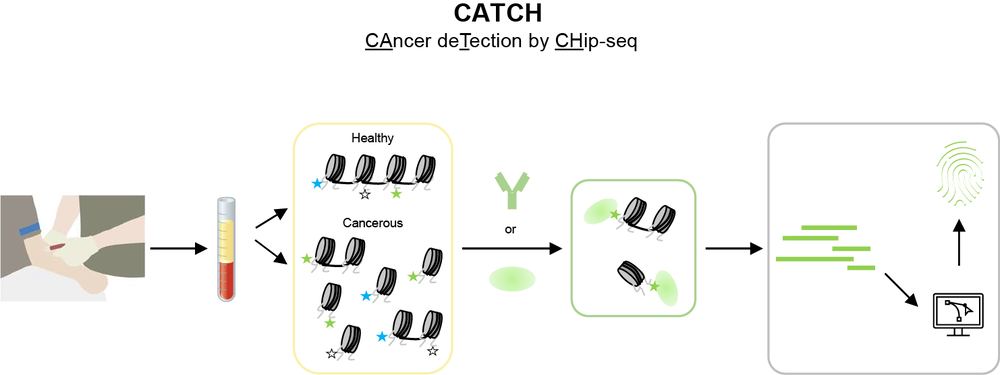
To be meaningful, early malignancy screening requires reasonably feasible sampling, robustness, and high sensitivity. John Arne Dahl and his group are bringing together existing tools in a new way to detect cancer as early as possible, using ordinary blood samples.
The new method is named CATCH (CAncer deTection by CHip-seq) and comprises reagents, laboratory methods, and bioinformatic analyses. CATCH combines the group’s extremely sensitive laboratory assay with custom-made reagents, and cutting-edge bioinformatics to “catch” signs of cancer cell DNA, in ordinary blood plasma, reproducibly and with high sensitivity.

Strong interdisciplinary team
The project is led by Dr. John Arne Dahl (CRESCO, Oslo University Hospitals - OUH), an experienced group leader with a strong track record, and more than a decade of expertise in advanced ChIP-seq technologies. He invented the patented ultra-sensitive, low-input ChIP-seq platform underpinning this project.
Dr. Arne Søraas (OUH) brings extensive medical experience in clinical studies to optimally use patient samples provided by the clinicians and OUH Professors Åslaug Helland (lung), Tobias Gedde-Dahl (blood), and Ingvild Vistad (gynaecological).
Dr. Mads Lerdrup (CRESCO PI, University of Copenhagen) is a group leader and a world-leading specialist in computational biology.
Dr. Michel Choudalakis (CRESCO, OUH) is a chromatin chemist that will coordinate the experimental work, and lead data processing and analysis. He brings the know-how to develop the reagents, standardize the method, and leverage multi-copy repeats to further improve method sensitivity.