
Gene Regulation and Genome Stability in the Earliest Stages of Life
Some of the most profound events in the life of an organism, with far-reaching consequences for development and health, happen during the very early stages of existence. These include completion of meiosis, merging of parental genomes at fertilization, and reprogramming of chromatin during early embryo development.
Despite its evolutionary conservation, conception is associated with chromosome errors and an unexpectedly high frequency of pregnancy loss and congenital disorders.
In CRESCO, we propose to use cutting-edge technology to study in exquisite detail the roles of dynamic and reversible epigenetic and epitranscriptomic modifications in oocyte and the early embryo, including their functions in genome stability, chromosome segregation and retrotransposon activity.
An overarching goal is to understand the role of epigenetic and epitranscriptomic information in the passing of life from one generation to the next in the One Health perspective
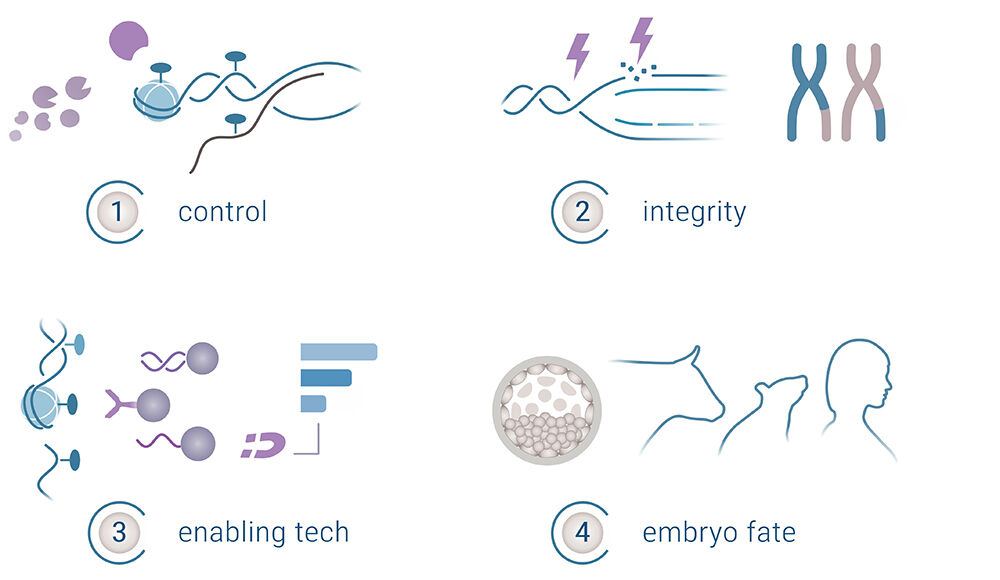
Research Area 1 - Control
This research area focuses on understanding the epigenetic and epitranscriptomic dynamics during oocyte meiosis and early embryo development, which are critical for successful transcriptional reprogramming in embryos.
To establish a solid foundation for this research, we will leverage small pools of oocytes and embryos to map key epigenetic modifications and the m6A modification on RNA, while simultaneously validating a patented single-cell ChIP-seq technology. The research will be conducted on mice and livestock, investigating significant stages of meiosis and early development, to create a reference map of epigenetic and transcriptomic changes.
Our objectives include a comprehensive analysis of the spatial and temporal activities of relevant epigenetic and epitranscriptomic indicators, utilizing innovative techniques like CRISPR/Cas9 and live cell imaging for studying cell polarization. We aim to elucidate how specific epigenetic and epitranscriptomic regulators affect developmental outcomes, leading to insights about genome regulation and the mechanisms of reproduction.
Additionally, the project will encompass genetic screens and assessments of heritability effects through various fertility techniques, ultimately enriching our understanding of embryonic development from both a basic and applied perspective.
Research Area 2 - Integrity
Meiosis is a crucial process in sexual reproduction and is present in all eukaryotes. This process should result in correct recombination and error-free segregation of parental chromosomes. However, there is a high incidence of abnormal embryo development due to chromosome errors in meiosis, which is critical for the healthy development of both human and livestock embryos.
DNA is essential for the transmission of genetic information but has limited chemical stability and is prone to damage that must be repaired by specific enzymes. It is known that epigenetic and epitranscriptomic factors play a key role in the stability and management of DNA double-strand breaks, but the exact mechanisms are still unknown.
We will use mouse models to investigate how specific mutations affect chromosome errors, spindle assembly, and mutagenesis in oocytes and early embryos. The research will also focus on the significance of epitranscriptomic mechanisms and unique genomic structures such as G4 and R-loop structures, as well as retrotransposons that may influence genome stability. G4 structures are known to play regulatory roles during DNA replication and gene expression, while retrotransposons depend on epigenetic factors for their integration into the genome.
We aim to clarify these structures and their regulation in oocytes and early embryos, which are relatively understudied. Our goals include studying the relationship between mutations and chromosome errors, identifying the roles and activities of epitranscriptomic markers, and evaluating the behavior of retrotransposons during meiosis and early embryo development.
Research Area 3 - Enabling Tech
Here, we build on previous studies that focus on the dynamic reprogramming of oocytes and early embryos (Research Area 1) as well as their roles in genome stability (Research Area 2). Our aim is to develop sensitive methods for analyzing the transcriptome, epigenome, epitranscriptome, and proteome using limited amounts of cellular material. Recent advances utilize magnetic nanoparticles for nucleic acid isolation.
Although oocytes are among the largest cells in the body, their limited numbers pose a significant challenge for proteomic analysis.. The first proteome analysis of single oocytes identified approximately 500 proteins, and ongoing developments will enhance this field. Research in epigenomics will focus on nucleic acid extraction, with the goal of improving techniques such as ChIP-seq by employing nanomachines that utilize magnetic nanoparticles for increased efficiency.
In terms of epitranscriptomics, new methods have been developed for analyzing m6A modifications in single cells, with plans to adapt these techniques for other RNA modifications.
We will also explore enzymes related to epitranscriptomic processes and DNA repair in oocytes and early embryos, using innovative nanoparticle technologies for high-resolution genomic and proteomic studies.
Our interdisciplinary team includes experts in protein purification and nanoparticle technology, and we will collaborate internationally to enhance omics technologies in developmental biology.
Research Area 4 - Embryo Fate
Frequent developmental failures in oocytes and embryos present significant challenges in livestock breeding and human reproductive medicine, including in vitro fertilization (IVF). In livestock, factors like poor oocyte quality and sperm DNA methylation affect breeding outcomes. For humans, despite advancements in IVF technology, only about 10% of oocytes lead to pregnancy, causing emotional stress and high costs for couples. The inefficiencies in both contexts underline the need for deeper understanding of epigenetic and epitranscriptomic influences on oocyte and embryo development.
Recent findings suggest that early bovine development may closely resemble early human development. Norway’s strong history in livestock breeding and access to fertility data uniquely position it to investigate these issues. This research area will focus on characterizing oocytes and embryos using diverse methods, correlating epigenetic factors with developmental failures, and exploring their diagnostic potential.